
Description
PrymaLab · Research Use Only
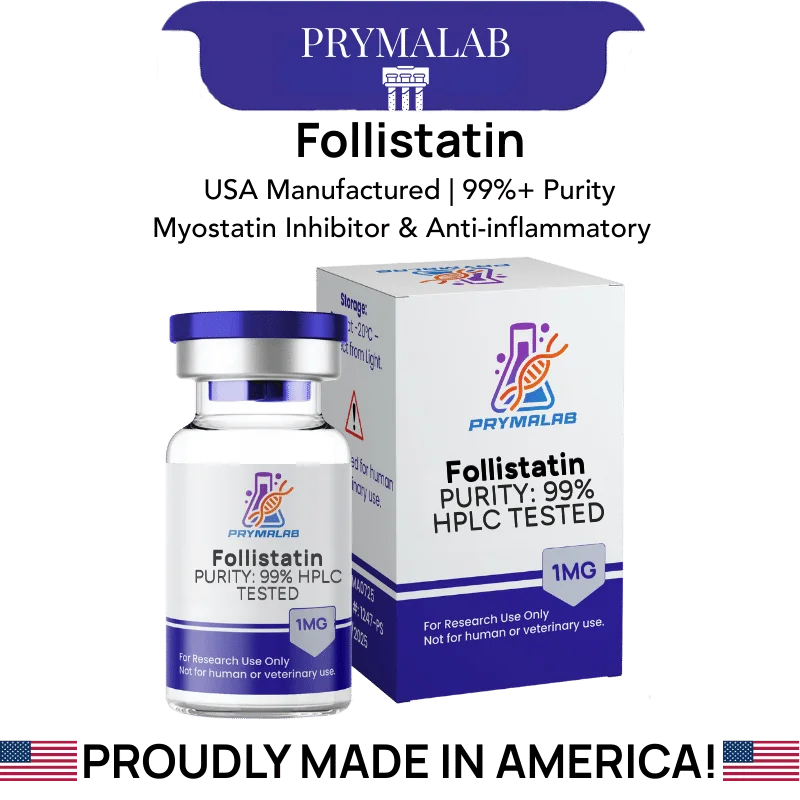
Follistatin 344 1mg
What the number actually refers to
The number in follistatin 344 is a residue count, and it counts residues in a precursor rather than in the protein that ends up circulating. Understanding what gets removed, and what the removal changes, is most of what a researcher needs from this listing.
Specification Table
| Property | Value |
|---|---|
| Compound | Follistatin |
| Article type | Recombinant glycoprotein, not a synthetic peptide |
| What 344 refers to | The residue count of the FST344 precursor, including its signal peptide |
| Relationship to FST317 | The two arise from alternative splicing of the same gene |
| Mature form derived from FST344 | The longer circulating species, commonly written FS-315 |
| Mature form derived from FST317 | The shorter species, commonly written FS-288 |
| Approximate mass | Around 38 kDa, varying with glycosylation |
| Why the mass is approximate | Glycosylation is heterogeneous, so intact mass is a distribution rather than a single figure |
| Principal binding partner | Activin A, bound with high affinity |
| Other reported partners | Several TGF-beta superfamily ligands including myostatin and certain bone morphogenetic proteins |
| Heparin binding | A property of the shorter FS-288 form rather than of this one |
| Expression system | Per certificate. It determines the glycosylation pattern and should be stated |
| Appearance | White lyophilized powder |
| Storage, lyophilized | 2-8°C short term, -20°C for extended storage, protected from light and moisture |
What Does the 344 in Follistatin 344 Refer To?
The 344 in follistatin 344 is a residue count, and the thing it counts is not the protein that does the work.
The follistatin gene produces two principal transcripts through alternative splicing, conventionally written FST344 and FST317, and the numbers are the lengths of the precursors those transcripts encode.
Each precursor carries a signal peptide of 29 residues that is removed during secretion, so the mature products are 315 and 288 residues respectively.
That is where the other pair of numbers in this literature comes from. FST344 gives FS-315. FST317 gives FS-288.
A single naming convention would have been easier and the field has two, which is why the same molecule appears in papers under both labels.
The practical version is short. Follistatin 344 names the longer precursor, and material supplied as follistatin 344 corresponds to the longer mature species.
The difference between the two mature forms is a 27-residue acidic tail present on the longer one and absent from the shorter one.
That tail is not decorative. It is the reason the two forms distribute differently.
What Does the Extra Tail Change?
The 27 residues that distinguish the two mature forms change where the protein goes rather than what it binds.
The shorter form, FS-288, binds heparan sulfate proteoglycans on cell surfaces and in extracellular matrix. It is therefore largely cell-associated and acts locally.
The longer form does not bind heparan sulfate appreciably, because the acidic tail interferes with the basic surface region responsible for that interaction.
So the longer form circulates and the shorter form stays where it was made.
Both forms bind activin A with high affinity, so the follistatin 344 product differs from the shorter one in distribution rather than in target selectivity.
For an experiment that distinction decides which form is appropriate more often than any affinity figure does.
A study of local signalling in a tissue preparation wants the cell-associated form. A study of a soluble ligand trap in circulation wants the other one.
Ordering by name alone will not reliably get the right one. Suppliers use the follistatin 344, 317, 315 and 288 labels inconsistently and sometimes interchangeably.
Asking which mature form the material corresponds to, in those terms, is the question that resolves it.
What Does Follistatin Bind?
Activin A is the canonical partner, and the interaction is close to stoichiometric. That is what makes follistatin 344 useful as a reagent.
Two follistatin molecules wrap around one activin dimer. Between them they occlude the surfaces the ligand uses to engage its receptors.
That is neutralisation rather than competition, and it is why the protein is described as a trap.
The same architecture works on several other members of the TGF-beta superfamily, though with lower affinity and with real variation between family members.
Myostatin is among the reported partners, which is why this protein appears in the muscle biology literature alongside the GDF-8 material in this catalogue.
Certain bone morphogenetic proteins are also reported partners, and the affinities there are lower again.
The useful caution is that affinity figures for the non-activin partners vary considerably between publications, because they depend heavily on the assay format and on which follistatin form was used.
Quoting a single number for follistatin binding to myostatin without naming the form and the method is the common error in secondary sources.
Anyone using this protein as a trap should establish the working stoichiometry in their own system rather than inheriting it from a paper that used a different one.
Why Is Verification Different for a Glycoprotein?
Every other verification argument in this catalogue assumes a defined small molecule with one exact mass. None of it applies to follistatin 344.
Follistatin 344 is a recombinant protein carrying attached carbohydrate, and glycosylation is heterogeneous by its nature.
Different glycan structures occupy the same sites on different molecules in the same preparation, so intact mass is a distribution centred near 38 kDa rather than a single figure.
A certificate quoting one exact mass to four significant figures for a glycoprotein has quoted something the material does not have.
The methods that do apply are different ones. SDS-PAGE establishes apparent molecular weight and shows aggregation or fragmentation as extra bands.
Reverse-phase or size-exclusion chromatography establishes homogeneity and detects multimers, which matters because aggregated protein is inactive and common.
A functional binding assay against activin A is the only method that establishes the material does what it is supposed to do, and it is the field most often missing.
Endotoxin is a fifth field with no equivalent in synthetic peptide work. Recombinant protein expressed in bacteria carries lipopolysaccharide unless it has been removed, and in any cell-based system that is a confound rather than an impurity.
The expression system should be stated for the same reason, since it determines the glycosylation pattern and whether endotoxin is a concern at all.
A sixth field is worth requesting and rarely appears: the buffer the material was lyophilised from.
Proteins are formulated with excipients, commonly a sugar, a salt and sometimes a carrier protein, and those excipients are part of the vial contents.
A nominal 1 mg fill of a formulated protein may contain considerably less than 1 mg of follistatin 344, and the certificate should say which figure the label refers to.
How Should Follistatin 344 Be Used as a Trap?
Using a binding protein to remove a ligand from a system sounds simple and it has a specific arithmetic that decides whether it works.
The interaction with activin A is close to stoichiometric, which means the useful question is molar ratio rather than concentration.
Two follistatin molecules engage one activin dimer, so complete neutralisation needs at least a twofold molar excess and in practice rather more.
That calculation requires knowing the activin concentration in the system, which is often the harder measurement of the two.
Where it is unknown, a titration is the honest route. Run a series of follistatin 344 concentrations and identify where the response plateaus.
The plateau is the informative part. A trap that has removed all available ligand produces no further change as more is added, and the concentration at which that begins is the working figure.
Pre-incubation matters as well. Adding follistatin 344 and ligand to a system simultaneously gives the ligand time to engage its receptors before the trap can bind it.
Mixing the two first, then adding the mixture, removes that race and usually produces a cleaner result.
Two controls are worth building in. A trap-only arm establishes that the protein has no effect of its own in the system, and a heat-inactivated arm distinguishes binding from anything the preparation carries with it.
That second control catches endotoxin, which is the contaminant most likely to produce a real effect that has nothing to do with the protein.
How Should the Vial Be Handled?
Follistatin 344 needs protein handling rather than peptide handling, and the differences matter more than the similarities.
Sealed lyophilized material holds at 2 to 8 degrees Celsius short term and at minus 20 or below for longer, protected from light and moisture.
Bring the vial to ambient temperature before opening, then reconstitute gently, because proteins denature at air-liquid interfaces far more readily than short peptides do.
Do not vortex. Add the diluent down the wall, leave it to stand, and swirl only if needed.
A carrier protein is often recommended for dilute working solutions, because protein at low concentration adsorbs to surfaces and denatures, and bovine serum albumin is the usual choice where the assay tolerates it.
Aliquot on first reconstitution without exception. Freeze-thaw cycling is more damaging to a 38 kDa protein than to a hexapeptide and the damage shows up as aggregation rather than as a mass change.
Avoid storing dilute solutions at 4 degrees Celsius for extended periods, since aggregation proceeds slowly at that temperature and is not visible until it is substantial.
Record lot, expression system, reconstitution buffer, concentration and date. Buffer composition belongs in that list for a protein in a way it does not for a peptide.
One closing note on aggregation, because it is the failure that catches people out.
Aggregated protein does not announce itself. A solution can look completely clear and still carry a substantial multimeric fraction.
Dynamic light scattering answers the question directly where the instrument is available, and a spin at high speed before use removes the largest species where it is not.
Neither step recovers activity that has already been lost. Both stop a compromised preparation from entering the experiment unnoticed.
The habit worth building is to check once on first reconstitution and again before any run that matters, since the multimeric fraction grows with time in solution rather than appearing all at once.
A preparation that was clean on Monday is not necessarily clean on Friday, and nothing visible will tell you which.
Published Literature
Selected references on the isolation of this protein, on the two forms and on the binding partners.
- Ueno N, Ling N, Ying SY, Esch F, Shimasaki S, Guillemin R. Proceedings of the National Academy of Sciences. 1987;84(23):8282-8286. DOI: 10.1073/pnas.84.23.8282
- Shimasaki S, Koga M, Esch F, Cooksey K, Mercado M, Koba A, et al. Proceedings of the National Academy of Sciences. 1988;85(12):4218-4222. DOI: 10.1073/pnas.85.12.4218
- Sidis Y, Mukherjee A, Keutmann H, Delbaere A, Sadatsuki M, Schneyer A. Endocrinology. 2006;147(7):3586-3597. DOI: 10.1210/en.2006-0089
- Thompson TB, Lerch TF, Cook RW, Woodruff TK, Jardetzky TS. Developmental Cell. 2005;9(4):535-543. DOI: 10.1016/j.devcel.2005.09.008
- Lee SJ, McPherron AC. Proceedings of the National Academy of Sciences. 2001;98(16):9306-9311. DOI: 10.1073/pnas.151270098
Frequently Asked Questions
What does the number 344 refer to?
The residue count of the FST344 precursor, including a 29-residue signal peptide that is removed during secretion. The mature product is 315 residues.
What is FST317 then?
The other principal transcript from the same gene, produced by alternative splicing. It yields the shorter mature form of 288 residues.
Why does the literature use two numbering systems?
One counts the precursor including the signal peptide and the other counts the mature product after cleavage. FST344 gives FS-315 and FST317 gives FS-288.
What is the difference between the two mature forms?
A 27-residue acidic tail present on the longer form and absent from the shorter one. It changes distribution rather than binding.
What does that tail do?
It interferes with the basic surface region that binds heparan sulfate, so the longer form circulates while the shorter form stays associated with cell surfaces and matrix.
Which form should an experiment use?
A study of local signalling in a tissue preparation wants the cell-associated shorter form. A study of a soluble ligand trap wants the longer one.
What does follistatin bind?
Activin A with high affinity, close to stoichiometrically. Two follistatin molecules wrap one activin dimer and occlude the surfaces it uses to engage its receptors.
Does it bind myostatin?
It is a reported partner, with lower affinity than activin and with real variation between publications depending on the assay format and which follistatin form was used.
Is this a peptide?
No. It is a recombinant glycoprotein of roughly 38 kDa, which means the verification methods that apply to synthetic peptides do not apply here.
Why can it not have one exact mass?
Because glycosylation is heterogeneous. Different glycan structures occupy the same sites on different molecules in one preparation, so intact mass is a distribution rather than a number.
What should the certificate carry instead?
SDS-PAGE for apparent molecular weight and aggregation, chromatography for homogeneity, a functional binding assay against activin A, an endotoxin figure, and the expression system.
Why does endotoxin matter here?
Recombinant protein expressed in bacteria carries lipopolysaccharide unless it has been removed. In any cell-based system that is a confound rather than an impurity, and it has no equivalent in synthetic peptide work.
Compliance Statement
Follistatin 344 is sold exclusively for laboratory research use. It is not a drug, food, or cosmetic product, and it is not a dietary product of any kind. It is not approved by the FDA or any comparable authority for human or veterinary use, it is a recombinant glycoprotein rather than a synthetic peptide and the analytical methods that establish identity for a peptide do not establish it here, reported affinities for partners other than activin A vary considerably between publications and with assay format, and no compound in this range is offered for any human or veterinary purpose. This product is not intended to diagnose, treat, cure, or prevent any disease. It must not be given to humans or animals. Purchase is restricted to qualified researchers and institutions operating within applicable laws. All handling is the responsibility of the purchasing laboratory.
Other formats of Follistatin 344
Follistatin 344 is also stocked as Follistatin 344 6mg preloaded 3ml pen. Each listing states its own quantity and concentration, and the pen and vial comparison explains what changes between formats.














19 reviews for Follistatin 344 1mg